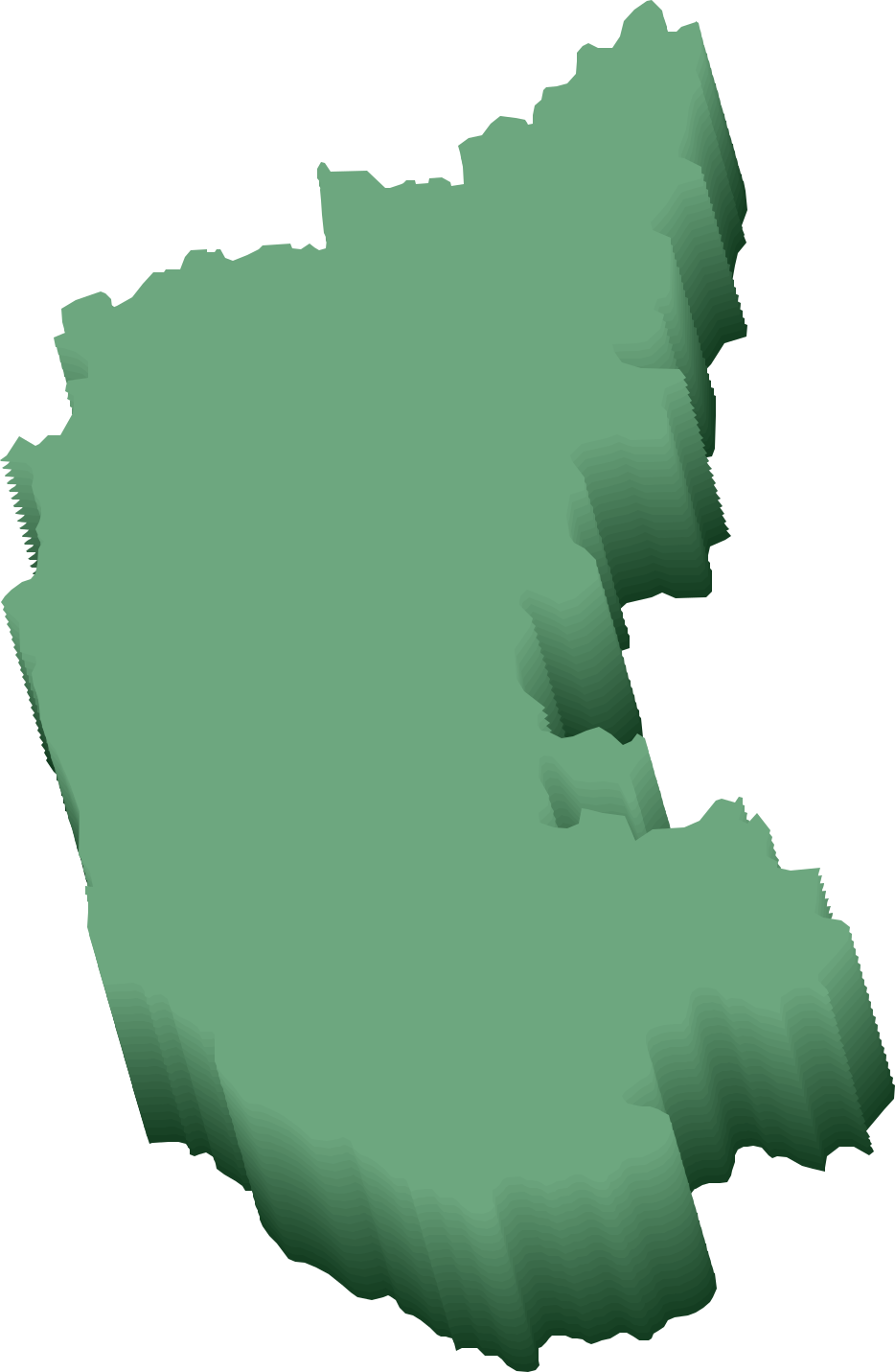
About Vijayapura (Bijapur) District (Karnataka)
Historically, it is believed that Bijapur district was founded in the late 900s under Tailapa II and by the 13th century, under the Khilji Sultanate. The city was named Vijapur or Bijapur in 1347 under the Bahmanis of Gulbarga. In 1518, the Adil Shahis ruled it. In 1686, it was conquered by Aurangzeb. During British period, British East India Company controlled it as in 1848 the region of Satara along with Bijapur was annexed to Britain's Bombay Presidency when the last ruler of both the places were died without a male heir. Then the British created a new district and named it as Kaladagi. The new district included today’s Bijapur and Bagalkot districts. After sometime in the year 1885 Bijapur was announced as the administrative headquarters of the district, when the headquarters were shifted from Bagalkot. After India got its independence in 1947, the district became a significant part of the Bombay state and was reassigned to Mysore state, later Karnataka on 1st November, 1956. The earlier southern taluks of the district were separated in 1997 to form Bagalkot district. Till 1997, Bagalkot District was the part of Bijapur. Badami, Aihole, and Pattadakal are the three prominent historical temples in the Chalukya architectural style, located near the place of Bijapur.
The district has many famous personalities. Sunil Kumar Desai was born in the year 1955 in Bijapur. He is an art and commercial Kannada film director. He has won the Karnataka state awards for the Best Screenplay & Best Dialogues categories and Film fare awards. Amirbai Bhaskara was born in Bijapur in modern Karnataka. He is also known as Bhaskaracarya. He was a famous Indian mathematician and astronomer of the 12th century. Four sections of his ‘Siddhanta Shiromani’ deal with arithmetic, algebra, mathematics of the planets, and spheres respectively. Kara?a Kautuhala is another great work of him.
Geographically, the district has a total geographical area of 10,498 sq. km. and occupies the ranks 4th in State and 51st in India. It lies at 13°29'N latitude, 77°80'E longitude and 120 m altitude. In the year 2023, there was a total 0.25% forest area of total geographical area. It is bounded by Gulbarga District on the East, by Raichur District on the South-West, by Bagalkot District on the South and South-West, by Belgaum District on the West, and by the Maharashtra of Sangli on the North-West and Sholapur on the North, Sangli on the North-West. The climate of the district remains pleasant throughout the year. Most of its rainfall occurs in the monsoon season. The actual rainfall in the district was 661.3 mm in the year of 2024-2025.
Administrative wise, the district is divided into 5 sub-districts namely Bijapur, Sindagi, Indi, Muddebihal and Basavana Bagewadi. Moreover, it has 6 towns and 679 villages. Kannada is its official language. The district of Bijapur came into existence on 1st November, 1956, in the state of Karnataka with an allotted district code of 557. Bijapur is its district Headquarters which is located at a distance of 523 km. from the State Capital.
Demographically, according to 2011 census, the district comprising a total number of 4,05,076 households with a total population of 21,77,331 including 11,11,022 are males and 10,66,309 are females. The population growth rate during the period 2001-2011 was 20.50% out of which 19.93% were males and 21.10% were females. The density of population of the district is 207 persons per sq km. The sex ratio is pegged at 960 (females per 1000 males) while the child ratio stands at 931 (females per 1000 males). Furthermore, the district has an estimated projected population of 26,55,233 comprising 13,56,782 males and 12,98,451 females for the year 2026. According to the National Family Health Survey (NFHS-5, 2019–21), the district has an estimated sex ratio of 995 females and a child sex ratio of 899 females per 1,000 males. As per 2011 census the percentage of major religions practiced by the people of this region is Hindu and Muslim with 82.07% and 16.97%. According to 2011 census, the principal languages in the district are Kannada at 74.96% and Urdu at 15.57%. In the year 2023 the number of live births in the district was 51,412 out of which 26,733 were males and 24,679 were females. In the same year the number of deaths in the district was 16,426 out of which 9,871 were males and 6,555 were females.
Economically, agriculture is the back bone of the district. Most of the parts are dependent on the monsoon for irrigation. Main crops of the region are maize and wheat among cereals, red gram, Bengal gram and green gram among pulses. Sunflower, groundnut and safflower are cultivated for oil. Horticulture industry is also growing very fast. Horticulture crops are grapes, pomegranate, guava, lime etc. only small scale industries can be found here. In the year 2023-2024 the Gross Domestic Product in the district was Rs. 48,09,503 lakh at current price and Rs. 26,80,556 lakh at constant 2011-2012 prices. The Net Domestic Product in the district during the period 2023-2024 was Rs. 41,40,729 lakh at current price and Rs. 22,57,000 lakh at constant 2011-2012 prices. The Per Capita Income or NDDP, At Factor Cost in the district during the period 2023-2024 was Rs. 1,64,897 at current price and Rs. 89,881 at constant 2011-2012 prices.
Education wise, according to 2011 census, the literacy rate in the district is 67.15% out of which 77.21% are males and 56.72% are females. The total number of literates in the district is 12,48,268 including 7,30,566 are males and 5,17,702 are females. In addition, according to the Periodic Labour Force Survey (PLFS) for the period July 2023-June 2024 estimated literacy rate in the district is 79.09% including 84.79% are males and 73.40% are females (Age 7 Years and Above). Now, it is growing as professional education hub. There are many under-graduate and post-graduate colleges for arts, science and social-sciences. Most of the under-graduate and post-graduate colleges are administrated by Rani Chennamma University. Professional institutions are affiliated by Visvesvaraya Technological University and Rajiv Gandhi University of Health Sciences. Sainik School prepares cadets for the Defence forces in the whole state.
During the year 2016, there were 2,837 foreign tourists and 19,07,671 domestic tourists who visited the district. There are so many historical and religious places to attract the visitors. These places are Bijapur, The Citadel, Mithari and Asar Mahals, Ibrahim Rauza, Bara Kaman, Twelve Arches, Saat Manzil, Seven-Storied Palace, Gol Gumbaz and Jumma Masjid.